Wednesday, June 5, 2013

Part 6 - Mt. Lewis

This was it. Golden Bowerbirds would put out of mind the sweat drenched nights camping, the Chowchillas would make us forget our over-drawn bank accounts and the Blue-faced Parrot Finch would be a good substitute for the Gouldian Finch that would not be seen on this trip.

All those cans of beans that we ate to sustain us would be worth it once we saw the birds of Mt. Lewis!

The hills calling our names
So it was with great anticipation that we set out that morning up the mountain. The cleared valley soon gave way to tropical forest as we diligently took our Hyundai up the dirt road. We stopped to observe Thornbills and Gerygones work the canopy, and the Bassian Thrush poke around the shaded road edges. Our main targets still remained higher up so we hopped back into the car and continued on.

Not too long afterward we spied some birdwatchers enjoying some Thornbills and Gerygones of their own. Out we got; introductions were made, battle plans laid out. Joy of the time and space expressed, and with it, espousal of the glory of the natural world. Many generations older then us, our 3 new companions nevertheless shared our passion for our feathered friends, and showed to be be young at heart.

All was good with the world until about 500 meters farther along the road. In its endless fury across the land, the wind had wrapped a young but promising tree in its fluid grasps and cast it across our path.

If we had been alone that would have been the end. We carried neither axe nor saw, and would have left before we had even begun. Thankfully, our new friend John, with his elderly wisdom had a small hatchet and modest hacksaw in his jeep.

Wielding the hatchet, I tore into the tree with a great fury, not to be denied the joys that the mountain offered. Limb by limb the road cleared. All took turns hacking, sawing and dragging away. Pretty soon, what looked like an impassable barrier opened up. Experience combined with youthful energy had done it. We were able to pass, though slightly more sweaty and that much more determined!

As we made our way up, we began to pass little grass clearings in the forest, the home of the Blue-faced Parrot-Finch. Ever watchful, we saw many finches, but of the Red-browed variety. With John's group pushing on ahead, I saw a green flash but couldn't stay on it. Surely a our query, but we would have to continue on. Not much longer and in a much wider clearing we got our birds. Flitting through the grass they were a delight for our road weary eyes.

Red-browed Finch
With no beer, or champagne, or even a pineapple to feast on to celebrate, we began a hike into the forest to try and find the remaining endemics of the Atherton Tablelands.  Tooth-billed Bowerbird, check! Chowchillas, check! Land leeches, yeah land leeches. Those buggers had a nasty little knack of creeping into your shoes magically, or feasting on your leg before you were able to wise-up to their nefarious dealings. One particularly sneaky individual got on my toe in my shoe, and when I accidentally squashed it simply walking, my shoe filled with blood and remained slick and gross for the rest of the day.

But I digress, this is about birds not leeches right? So we continued along hoping we'd get a Golden Bowerbird, the crown endemic of the land. Alas it was not to be. Our best efforts would not suffice this day.

Back at Kingfisher Park, we decided to stake out the little stream in hopes of seeing one of Australia's most enigmatic creatures, the Platypus. It started off well, with many birds coming to drink at the stream, a Pied Monarch feeding its young, and a Thick-billed Gerygone nest overhanging the water. However, we were soon beset by mosquitoes, and no matter how hard we tried to cover up, they found a way to feast on our flesh. After too long waiting, we gave up. No Platypus, only the lingering sting of mosquitoes and defeat.

Pied Monarch performing some acrobatics
The highs a lows of the tropics were starting to become apparent, and with the Daintree Rainforest waiting, we would see if we were up to the various challenges in our path.


Tuesday, April 16, 2013

Part 5 - My 1000th bird.

 I awoke to an empty tent. Peeking my head out of the door I took in the inside of the Abattoir Swamp viewing blind. I noted that the snake that had kept us company the previous evening had departed for greener pastures. It was time for us to do the same. Our next stop was the famous Kingfisher Park which held untold promises of birding glory!

Of course this glory is only rewarded to the folks that rise early with the sun and exhibit an unquenchable determination to overcome any and all obstacles between them and their sought after query. When I went to find Nicole she had already snagged 2 lifers in Lemon-bellied Flycatcher and Blue-winged Kookaburra. Clearly I'd have to pick up my game at this most important of stages.

Rolling along the road with open fields on either side, the forest was not at first obvious tucked back from the road. Upon turning off, the park's welcome sign  and forest rose to greet us. Excitement began to build. As we inched along the dirt road to the park office, we barely had to wait 10 seconds for the first of many amazing and incredible birds to appear from the forest. We didn't need to guess at which species we were looking at; the Buff-breasted Paradise Kingfisher was instantly recognizable with its striking colors, absurd tail feather, and its face on the park's welcome sign!


We make it to the park office despite ourselves, and hopping out, and are promptly greeted by another new bird, the cheery Pale-yellow Robin.

Still not having made it to the front door I look up to behold the exquisite Yellow-breasted Boatbill, a diminutive flycatcher with striking black and yellow plumage. I frantically get Nicole on the bird before it disappears into the canopy.

I will now pause this story to inform you, my dear reader, that the Yellow-breasted Boatbill was my 1000th bird species in life. There exists an adage in the birding community along the lines of : "No one but yourself cares about your bird list, not even your own mother." Perhaps that is entirely true, but seeing as this is my blog, I will bore you with the details and give you permission to take this moment to google the bird in question. Despite this auspicious milestone, I was not immediately aware that I had reached it, only vaguely cognizant that I was hovering around the 1000 marker. Anyway, there you have it folks, I had seen approximately 1/10 of the worlds bird species.

Back to the story. The formalities were taken care of so off we went with one of the owners, who graciously agreed to point out where there was a roosting Papuan Frogmouth. If you think the name sounds strange, wait till you see the bird. Bizarre and otherworldly spring to mind, and all together quite fascinating!

The rest of the day was quite incredible. We stalked the elusive Red-necked Crake, waited patiently for the Macleay's Honeyeater to eat its fruit offerings, and watched the comical Orange-footed Scrubfowl poke around in the leaf litter. I came within a foot of stepping on  Red-bellied Black Snake which bolted away faster then I have ever seen a snake move. Definitely a very shy snake considering its potent venom! We even outdid ourselves by having a proper shower for a change.
 
*Bird photos are Nicole's.*

Red-browed Crake in the undergrowth
Orange-footed Scrubfowl strutting down the road

Mr. Expert Guide also showed up to have a chat with the park owners. Our favorite Aussie birder even asked us where we had slept the night before. I still don't know why I lied, but I did. I quickly said, oh the park outside Mt. Molloy. In truth, as you well know, we had spent it in the viewing blind. I suspect he knew as well, having mentioned something about seeing our car in the parking lot after dark! Mr. I forget your name, I'm sorry I lied. I guess I felt slightly embarrassed and was caught off guard.

At least that night we had a nice patch of grass at the park to place our tents and rest up for our big day to Mt. Lewis the following morning. It promised to be a doozy. Stay tuned!

The tents!


Tuesday, April 9, 2013

Part 4: Great Bowerbird and that delicious Raspberry Soda

So it came to pass that on the fifth day... or was it six? seven? fourth?...  we found ourselves in Mt. Molloy.

Despite the completely different setting, this little town seemed entirely familiar. It was like that small town USA that I've stopped in countless times in previous adventures. On the surface seems completely dead, but you know there are a few surprises buried just beneath.

On the hot and dusty day, I was in for a few of those surprises. Stopping at the convenience store, I uncharacteristically purchased a popscicle and a raspberry soda. I have never recalled either tasting as good in all my years! Pleasant surprise number one!

Now one of the great things about small towns is that everyone knows what's happening, and upon seeing our binoculars, the local fellow kindly directed us just a minute down the road to the little town park. Here, he advised we would promptly see Great Bowerbirds and their bowers. Sweet! Pleasant surprise number two!

Having been schooled in bowerology by David Attenborough, and having been lead straight and true by the convenience store clerk, I was all smiles as the birds were found dashing here and there, never straying too far from their lavish bird cribs.


In all of life's myriad experiences, it can sometimes be hard to pin the essence of a trip, an experience, or an event. To realize the moment and accompanying feelings or quick actions that embody a great journey.

That day, having strolled down the sun scorched road with the taste of raspberry lingering on my tongue, I touched on the realization of the present. I was on the opposite side of the world from my home looking at birds that for me, personified the "Down Under". I had found that moment.

Realizations aside, the journey would continue. Sweeping past the sleepy town it was on to Abbatoir Swamp. Despite the name, we witnessed no animal slaughter. To this day, I wonder what great horror occurred there to earn such a black name. The promised Northern Fantail, who's holy light would have broken the evil that the name conjured up, did not materialize. Instead, we were mocked by the calls of the White-browed Crake and the Pale-vented Bush-hen, eternally damned to stalk the grassy marsh unseen.

The peaceful edge of Abattoir Swamp

A lone figure, clothed in white and after the fashion of Steve Erwin appeared in our midst. Who could this character be, we wondered. We quickly quickly realized he was a birder. Would he bring us birding salvation? For not only was this the first  Aussie birder encountered in our travels, but he was also a local guide and self -professed expert on birds of the region.

With the usual pleasantries exchanged, I let forth the questions that my heart so desired to have answered. Questions that all birders in foreign lands must have; where can the birds be found? Do they really exist or are the books just a cruel joke depicting forms that never evolved to grace this world with their beauty?

Expecting satisfaction, I was left with disappointment. He was not very forthcoming despite sitting on a vast wealth of bird knowledge. Even with a little coaxing, he manged but a few spots for us to explore, and with it, came a slightly grating personal reflection. He could not tell us where to find everything or he would not have any business.

I will only briefly reveal the holes in this logic. First, I will remind you in case you have forgotten, that we were three 24 year old boderline-broke Canadians. We hadn't showered in what felt like an eternity - minus the wash at the White-browed Robin spot -, we were living out of a dinky hyundai camping every night, and seemed to be subsiding on only canned tuna and beans! The potential for one of this fella's future clients to choose this type of "adventure" upon hearing from one of us that indeed species X  can be seen in location Y, is approximately zero. People that pay for guides are of a different spirit then the ones that return to Abattoir Swamp at night to sleep in the shelter of the viewing blind!

Despite the paucity of new information we did have one new spot to check; the local elementary school usually holds Squatter Pigeons (we thought we had missed our chance) and maybe a Red-crowned Parrot or two.

Normally, adult strangers strolling onto school grounds, binoculars ablaze, might raise a few eyebrows, especially in the good old United States of America where the media would have us believe that child abductors are waiting around every bend. However, in this delightful corner of the world, for our troubles we were rewarded with great looks at Red-crowned Parrots, and a kindly word from one of the teachers telling us that unfortunately, the Pigeons hadn't been around for the past few weeks and she was sorry we missed them. Now that's an attitude that I can get used to!


Part 3: No Squatter Pigeons here

The exact sequence of events escapes me. What I remember between Crater National Park and Mt. Molloy is a jumble of birds, torrential downpours, checking my email in the MacDonald's, searing heat and one extremely satisfying raspberry soda! So, in the vein of many travel writers, timeline be damned! Disjunct spots will hopefully coalesce into a broader picture as we made our meandering way North. This part of the trek past through drier country before coming back to the sub-topical feel at Mt. Lewis and to the tropical Daintree beyond.

The birds could not be found. The termite-mound dotted landscape whizzed by as I steadfastly took us forward. "There's another spot for them over here" became the line to spur on the troops. The "them" in question were Black-throated Finch, Squatter Pigeon and Black Bittern. Upon reflection, the season was wrong. Not that "they are not found here" wrong, but rather "won't be concentrated here" wrong. Termite mound after termite mound past with nary a living creature about. A country road on which our little Hyundai should not have traveled was our second to last spot for redemption. Some finches shifting through the dry grass got my attention. Not the ones we were looking for but instead the common Double-barred Finch. Using the moniker common may sound like I think less of this species than the aforementioned Black-throats, but such is not the case! These delightful birds would have girls worldwide swooning at their cuteness.

At Tinaroo Creek, down the aptly named Tinaroo Creek Rd, the Black Bittern could not be found. Clearly the finches' charm did not rub off on us. The well used verse, "I'll just have to come back another time", was uttered.

Coming back would of course require getting out. As I was heading down toward the creek, I felt us pass the point of no return in a soft muddy road. I knew that if I could not make it up the other side of the creek there would be no going back the way we came. I conveniently kept this information from my travel companions. *NOTE* (If the rental car agency is reading, I categorically deny going on any unpaved roads and thus breaking our rental agreement). Thankfully, we didn't have to charm any non-existent passerbys in the deserted countryside as I made it up the other side without issue.

So onward we went. Squatter Pigeon corner was noticeably void of any squatters; pigeon or other, and we would leave without seeing any of the species promised in our guide. C'est la Vie.

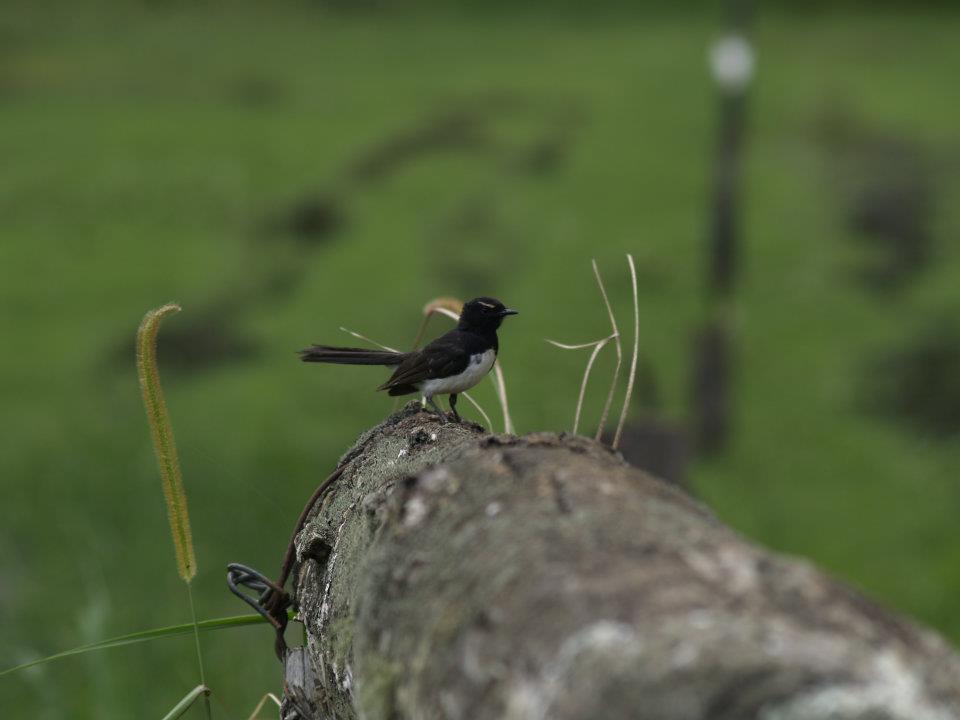
Willie Wagtail (One of the birds we did see!)

All was not amiss though. At some point in this jumble of a couple of days, the decision was made to drive "out of our way" so we could camp at an actual park. This proved to be a wise decision. The White-browed Robin, a specialty of the region happened to be nesting right at our camp site. Splashing around in the stream as it tumbled across the rocky substrate and around small tree islands, we listened and watched the bird flit from island to island. We even chanced a brief soak in the cool water to wash the road filth from our bodies.

And so it went. A stop here for Cotton Pygmy-Goose, and stop there for Green Pygmy-Goose. A black Kite here, a Brahimy Kite there. The list grew slowly. A distant Australasian Pelican would strangely enough, be the only one of the whole trip for me despite its professed common status. A few would not make it all; Saurus Crane and Apostlebird come to mind.

Neverless we kept on, with the occasional downpour sending us running back to the car to pursue Black-necked Storks another day!

We were careful not to hit any Kangaroos ;)


Wednesday, March 13, 2013

Part 2 - The Tablelands Begin

We arrived at Crater National Park at dusk. My bird finding guide to Australia promised Grey-headed Robin and Bridled Honeyeater in the car park (parking lot for us foreigners). Through the gloom we could make out a few birds, but morning would come soon enough, and with it, better light.

The Cows in this part of Oz are tough!

 That night began the "camping". I use quotation marks because, while we were certainly camping, invariably it occurred in spots where camping was, shall we say, not an official use of the area. That particular evening, we raised out tents in the car park.

The sun rose, but the forest remained dark. True to the book's word, the robin and honeyeater where easily found poking around just outside of our tents. With those two in the bag, the birding would get tough as we set out to try and find a Victoria's Riflebird. Foreign bird sounds reached my ears, and the novelty of a wholly new ecosystem stimulated and confused my senses. Peering into the dark canopy I searched in vain. Thankfully I had companions, and Nicole, in top form, had spotted one for me. My first bird of paradise! Like so many times in my life, that unbridled boyish joy could not be contained. A moment to savor in what I hope is the first of many as I journey through life. As is the case with most of the wonderful birds and places I dream of, my hope is that I reach them before the proverbial "progress of man" does. Better yet, I hope that from their shaded rainforest homes, the birds sing out to remind us of the world's endless forms most beautiful, lest we fire up the chainsaws and make our planet a much lonelier and poorer place.

 Despite the unfamiliar surroundings, my hunger for new birds enveloped me as I eased into my element. Through the park we went, binoculars poised and ears tuned to even the faintest rustle of leaves. However, the tropics can deny even the most ardent pursuer their catch. The Golden Bowerbird and the Fernwren would not yield from the gloomy forest regardless of my internal yearnings. 

Nicole taking a break from birding

 With only 12 days and lots of ground to cover, it was time to move on. As we began the slow drive out, not one, but four Southern Cassowary wattle on to the forest road. Two adults and two young, we couldn't' have been any luckier. Ignoring us, they worked the road and then as quickly as they came, melted back into the forest. These birds, with insanely powerful legs and a don't mess with me attitude, are the guardians of the forest. They eat up to 50 different kinds of fruit and maintain its diversity and health by propagating seeds throughout the forest.


Slipping by.
 This trip is going to be one hell of a ride!


Part 1 - Etty Bay and Australia Day


It was to the promise of spectacular endemic birds, saltwater crocodiles and ancient rainforest that me, Nicole, and her friend Ali undertook an ill-planned adventure. Now perhaps ill-planned is not the right term. You see, when your objective is birds, and the location happens to be in the tropics, no amount of planing will save you. You have to go with the flow, make on-the-spot decisions and live with the results. Its a thinkers game. Maximize the number of endemic birds with the limited amount of time and money that you have and hope you make the right choices! And in an expensive place like Australia, limited funds do become a problem if you're not frugal!

Rental Car = $600
Binoculars = $400
Bird finding guide = $40
Swimming Trunks = $5
Ball cap = $7

Birding roadtrip in Australia = Priceless!!


So off we went. Roundabouts, Macas, wallabies and the prospects of new and exciting birds blurred together as I took to the road on the left for the first time! The great-barrier reef and greyhound hopping were done (tales for another post) and it was time to head out of Cairns to the Atherton Tablelands, Marreeba, Mt Lewis and the Daintree Rainforests.

This is great! With a vehicle, the birds will fall like republican presidential candidates, hard, fast and in quick succession.

Out of the city and at the first birding stop we get......................................nothing. No Pratincoles or Little Curlews to delight us, only empty sod farms and one freshly road-killed Sharp-tailed Sandpiper. Ironically, I was incapable of finding an alive Sharp-tailed Sandpiper in Australia or New Zealand despite concentrated efforts. Naturally, this bird now ranks very highly on my nemesis list which I keep in my head. For the record, this list also includes other great luminaries such as the Audubon's Oriole, the Manx Shearwater and the Sabine's Gull.

Contemplating the lack of birds (the sod farms were behind me)!


With this scintillating start we made another important choice. Our original destination was Crater National Park in the Atherton Tablelands and while Southern Cassowary range throughout the area they weren't a guaranteed thing. Consequently, having received some intel on a can't miss spot for this species we adjusted our plan. The thing is, it was quite out of the way, but with a bird like the Southern Cassowary, it's one you just can't miss.

With figurative dollar bills flying out the end of the tailpipe, we arrive at Etty Bay. This should be a cinch. Oh right, it's Australia Day and the place looks like Miami Beach during Spring Break...... just our luck. With a sheepish air, we take to the water for a swim thinking the birding gods would not be favoring us today!

Lost in thought, Nicole suddenly loses her mind and starts yapping hysterically. Sure as hell, a Cassowary is strutting down the lane toward the beach oblivious to the drunk revelers. Looks like our luck had turned. We spend the next 20 minutes or so following the bird around as it searches for fruit amongst the people and cars. We even posed for a few pics before finally making our exit and hitting the road.

Working the beach away from the party-goers.

Posing in front of the star attraction.

Thursday, January 3, 2013

An Ode to the Tip

In a place that conjures up thoughts of a bleak grey existence, punctuated by tall rises and strip malls, there lies an apparent enigma. It exists as you break away from the endless city and across fields of corn and tobacco that fuel our own self-destruction. Past cottages, full of temporary relief and cheap beer, past gas guzzling SUVs towing equally gas guzzling powerboats, and past shops selling vanity and excess.

It is Southern Ontario's wild. Long Point.

Thirty-five kilometers of land, with an unbroken shoreline on one side, and a thriving bay on the other, it is the antithesis of Toronto. At its end, the feather in its cap. A Long Point Bird Observatory field station. The Tip.

For five weeks, August through October, I had the pleasure of calling the Tip my home.

Access is by boat and cell reception is minimal. The power is solar, and supplies few. It is Southern Ontario's version of island life. Windswept and lorded over by a lighthouse, its sandy soil and phragmites choked ponds become the back drop of one of nature's finest events, the fall migration.

Forsaking their temporary homes in the north, birds, of all varieties, pour south. Instinct and urgency drives them, and the Tip becomes both a refuge for this southward journey and a vantage point from which to witness the spectacle.

Simply sit, watch and listen.

On a good day, the warblers pour off the lake, diving into the vegetation bordering the beach. Thrushes, viroes, and sparrows stalk the willows and wild grape vines, while sapsuckers, nuthatches and creepers scale the poplar trunks. Skeins of geese pass overhead, while the finches chiurp away in bounding flight. Over the water, gulls, cormorants and ducks stream by, indifferent to our scopes and notebooks. All are being driven by the change in season, and by the most fundamental need, survival. Some will not travel far. Others are just beginning their trek which will take them to the heart of the Amazon and beyond.

Positioned at the end of this somewhat unassuming stretch of land, I was privileged enough to share in its beauty and secrets. I was privileged enough to have brief glimpses into the birds' frantic and fascinating lives.

At the station, we trap and band birds for research. Every morning from August until November, birds are caught, banded and released. For 60 years this has been happening at Long Point. The wealth of data collected is used to inform us of our feathered companions' doings, and to aid them in their struggle against the never-ending onslaught of human kind. In my time, I banded 888 individuals of 77 different species. I marveled at the feistiness of a Yellow-throated Vireo, of the softness of a Saw-whet Owl and the adorableness of a Yellow-bellied Flycatcher. I was joyed by the cryptic beauty of an American Woodcock, the flashiness of a Canada Warbler and of the character of a Red-breasted Nuthatch. Each species, and each bird, unique and wonderful in its own.

In reflection, surrounded by the birds, restlessly moving onward, my soul was transported to a distant past. My conscious was connected to the primeval urge to be a part of the seasonal movement. And when the birds took off, so did I!